Human-directed systems

Small cores.
Open composition.

Skaldos is an independent open-source home for system foundations that keep runtime behavior explicit, ownership local, and extension possible without forcing policy into the core.

Skaldos strand-knot mark

Workshop book / 01

The method behind
the systems.

Architecture Cycle-Driven Development reconstructs how DIX and ROBA actually evolved: decisions, failed abstractions, counterarguments, pressure tests, and deliberate replacements—not polished hindsight.

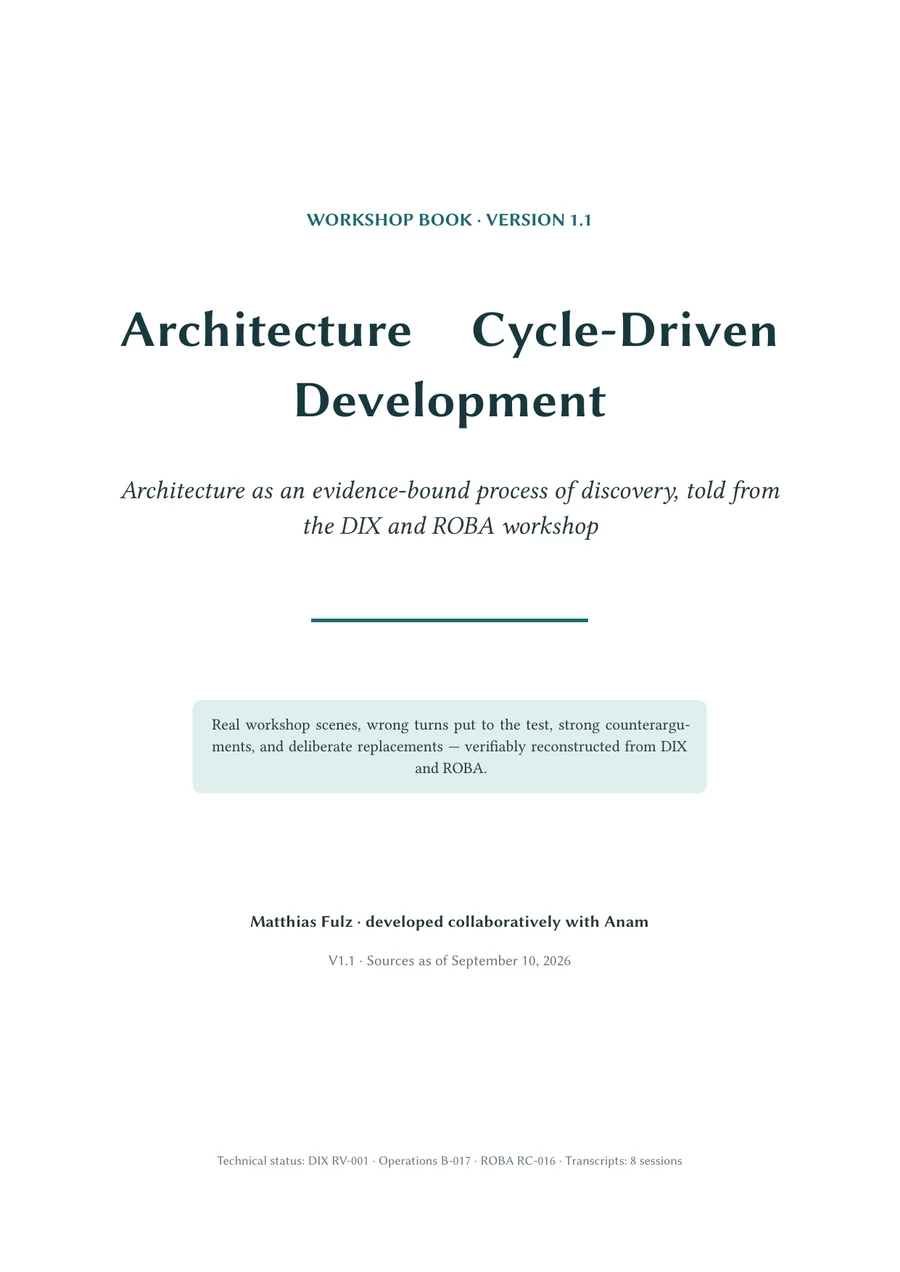
Cover of Architecture Cycle-Driven Development, English edition

Architecture Cycle-Driven Development

Architecture as an evidence-bound process of discovery.

Real workshop scenes show architecture emerging through cooperative reasoning rather than being rewritten as a clean success story afterward. The book preserves wrong turns, their evidence, and the reasoning that replaced them.

Edition
Version 1.1
English
101 pages
Deutsch
104 Seiten
Format
Tagged PDF · A4

Projects / 02

Two foundations.
One direction.

DIX and ROBA solve different problems. Both start from the same refusal: infrastructure should not hide ownership, policy, or trust boundaries behind convenient magic.

DIX mechanical basilisk in berry and ivory

DIX

Declarative Interface eXecutor.

A Python toolkit for assembling isolated component, composition, application, and module graphs into explicitly exposed local functions.

DIX on GitHub →
ROBA mechanical basilisk in green and ivory

ROBA

Local context state with explicit access boundaries.

An ephemeral context-state service built around process boundaries, Unix sockets, typed locators, scoped state, and deliberately narrow authority.

ROBA on GitHub →

Principles / 03

Control stays visible.

The projects are built for composition rather than assimilation. Higher layers may become opinionated. Their lower foundations should remain narrow, inspectable, and replaceable.

01Explicit over implicit

Loading, exposure, authority, and adaptation should be visible operations—not ambient side effects.

02Ownership before convenience

The layer that can actually decide semantics should own them. The core does not guess on its behalf.

03Composition over capture

Useful behavior remains independently replaceable instead of being absorbed into one universal runtime.

04Process boundaries are real

Trust claims stop where the operating system and the concrete runtime can no longer enforce them.

05Contracts without theatre

A declared boundary should describe what is actually guaranteed—not create documentation-shaped certainty.

06AI remains a collaborator

AI can accelerate reasoning and implementation while human intent, review, and responsibility stay first-class.

About / 04

Built by
Matthias Fulz.

Systems architect, security nerd, and independent developer working where the solution is not already known.

My technical journey began with Linux, a book about C, and one very clear realization: This is fascinating—I want to understand how it really works.

Since then, I have focused on understanding complex systems down to their actual boundaries: where responsibility belongs, which abstractions remain stable under pressure, and what genuinely carries beyond a convenient prototype.

Under Skaldos, I develop DIX, ROBA, and Architecture Cycle-Driven Development as a connected exploration of composable software, controllable AI integration, and evidence-bound architecture work. Degrees and certifications document completed institutional processes—not depth of technical understanding. What matters to me is whether an idea survives technical scrutiny and proves itself in practice.

  • Bachelor of Science · FH Ingolstadt
  • Offensive Security Certified Professional · OSCP
  • Linux · C · Python · Security · Systems Architecture
Talk about systems, research, or collaboration →

Direction / 05

Build the proof.

This is a direction, not a promise. Every step must earn its place through concrete pressure tests before it becomes stable surface.

Now

  • Prepare the first public alpha
  • Publish honest architecture boundaries
  • Ship reproducible local examples

Next

  • Stabilize selected first-party modules
  • Connect DIX and ROBA through explicit consumers
  • Run real development workflows end to end

Explore

  • State-backed execution adapters
  • Contract and generation tooling
  • Human and AI-facing interfaces

STATUS: EARLY ALPHA PREPARATION — interfaces and project boundaries may still change deliberately.